09/10/2026
Voter Vocabulary: The Words Voters Use To Discuss Key Issues
This year, more voters than ever will turn to AI chatbots to learn about candidates — who they are, where they stand on the issues, and whether they have earned a vote.
There is abundant transparency everywhere else in the electoral process, from campaign finance reporting to online political ad libraries. What the popular AI models are saying about our elections, and what that might mean, is largely hidden.
As part of our Digital Readiness research, we are tracking the various ways candidates are communicating with voters online. This week we turned our attention to understanding what voters are hearing from AI models and where those models get their information.
We found that answers are not consistent within the same model, let alone across competitors, so there is no single answer to “what does AI say about this candidate?” And the websites the models rely on for election information offer a glimpse into how campaigners can shape what voters learn about them.
We asked ChatGPT, Claude, Gemini, and Grok three questions about 161 House and Senate candidates in 80 races:
We prompted each platform twice with each question, for a total of 3,816 answers. We logged every citation the models produced: 24,555 citation instances across 2,256 domains and roughly 15,000 unique pages.
For each response, an AI rater followed a grading rubric to score the answer on a five-point favorability scale and flagged whether it mentioned a specific criticism.
AI chatbots produce a new answer each time they are prompted, so for each model we asked the same question twice and measured how similar the two responses were. They often were not. Across 1,915 pairs of the same question, same candidate, and same model, the two answers earned the same favorability score 66% of the time and differed by a point or more in the remaining third.
In 7% of cases, one answer was rated positively while the other was rated negatively. More consequential for an individual voter’s decision: the models surfaced a specific criticism in one run but not the other 21% of the time. The platforms disagree with one another about as often as each disagrees with itself.
What a voter gets in response to a prompt depends on which model they ask and when they ask it. For campaigns, there is no single, consistent answer to the question of what AI says about your candidate.
The collection of citations from these responses reveals where the models are sourcing their information, which gives us an idea of how their answers might be influenced.
Looking at the share of answers that cite a given source at least once — a candidate’s own website appears in 55% of responses — shows how often a source is showing up in front of a voter.
| Source | Answers citing at least once |
|---|---|
| Candidate’s own campaign site | 55% |
| Wikipedia | 42% |
| Ballotpedia | 30% |
| house.gov | 21% |
| localcandidates.org | 10% |
| senate.gov | 9% |
| BallotReady | 8% |
| Associated Press | 6% |
| Giffords | 5% |
| FEC | 5% |
| DCCC | 5% |
On average, an answer cites about six sources. Across all 24,555 citations, regional press and related sites account for about 30% of the volume, while 20% go to official government pages, 15% to campaign sites, and 13% to voter reference sites like Ballotpedia. Wikipedia, which appears in 42% of answers, accounts for only 8% of total citations.
The citations also paint a picture of each model’s “style” when responding to election-related prompts.
| Model | Characteristic source | Second | Third |
|---|---|---|---|
| ChatGPT | house.gov (27%) | Associated Press (17%) | FEC (16%) |
| Claude | Wikipedia (44%) | Ballotpedia (32%) | GovTrack (16%) |
| Gemini | Ballotpedia (42%) | localcandidates.org (24%) | — |
| Grok | Campaign site (71%) | Wikipedia (64%) | — |
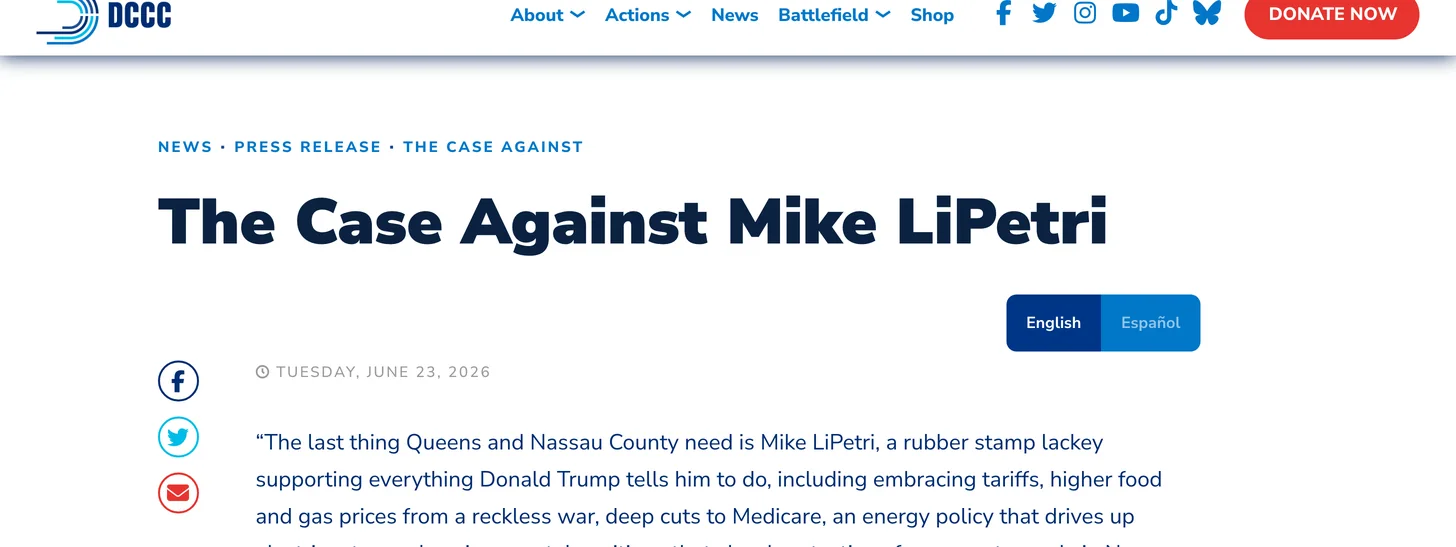
The Democratic Congressional Campaign Committee (DCCC) website, dccc.org, is cited in 146 answers about Republican candidates, or 7.5% of all answers about Republicans. Almost all of those point to the committee’s “The Case Against [Candidate Name]” pages. Grok and Gemini incorporate them the most.
NRCC.org, by contrast, is cited in 14 answers about Democrats, 0.8% of answers about Democratic candidates. Those are primarily press releases about Republican candidates that happen to mention the opponent. There is no equivalent series of similarly structured pages for the models to reference.
The DCCC’s page attacking Republican Mike LiPetri, running in NY-03, was cited in 9 of the 24 answers about him. The page’s structure, as much as its content, contributes to its outsized inclusion. There is one stable URL per candidate, titled with the candidate’s full name, in plain text, with links to primary sources — the shape models prefer to cite.
Endorsement sites show a similar pattern on the positive side. EMILY’s List appears in 160 answers about Democrats (8.6% of answers about Democrats) and Giffords in 196 (10.5%). On the Republican side, iVoterGuide from the American Family Association appears in 137 answers (7.1% of answers about Republicans), Club for Growth in 43, and SBA Pro-Life in 23.
This is not a story about model bias, but one about one side being more adept at presenting candidate information in the way AI prefers.
A candidate’s own site was cited in 55% of answers about them, but the number varies significantly based on the question being asked.
| Question | Own site cited |
|---|---|
| Positions what are their positions on the major issues? | 69% |
| Persuasion why should someone vote for them? | 59% |
| Identity tell me about this candidate | 40% |
Incumbents are at a disadvantage here. Their .gov site, which models treat as more authoritative, is cited in 71% of answers about them, compared with only 43% for their campaign site. For a challenger, the campaign site is cited 63% of the time.
A response that cites a candidate’s own site does not improve the favorability rating, but the citation does ensure the campaign’s framing is present alongside whatever else the AI found.
There are three actionable takeaways for campaigners based on this analysis.