09/16/2026
What AI Is Telling Voters
A frequent refrain of practitioners on the Right, backed by observational data, is that Republican campaign’s emails are less likely to reach supporters’ inboxes than those of Democrats. We see the impacts of this in the disparity between partisan spending on Facebook advertising to build email lists and in grassroots fundraising. The partisan email divide exists, but why?
Our review of emails from 75 US House and Senate campaigns reveals a stark asymmetry in modern political tech infrastructure. Of the 35 Democratic campaigns we analyzed, 34 send their email from NGP VAN platforms and a single block of IP addresses is shared by 63% of these campaigns.
The Republican ecosystem, by contrast, is much more fragmented. The 40 campaigns we analyzed on the right send from more than a dozen different platforms across 25 unique IP address blocks. The most widely used IP address block only serves 33% of the campaigns we monitor.
This dichotomy has significant implications in whether or not campaigns’ emails reach voters’ inboxes.
NGP VAN, the primary provider of campaign software for the Left, has two email marketing platforms for candidates. Twenty two of the Democratic campaigns surveyed use the main NGP VAN platform to send emails and 12 use ActionKit, which was acquired by the company in 2019.
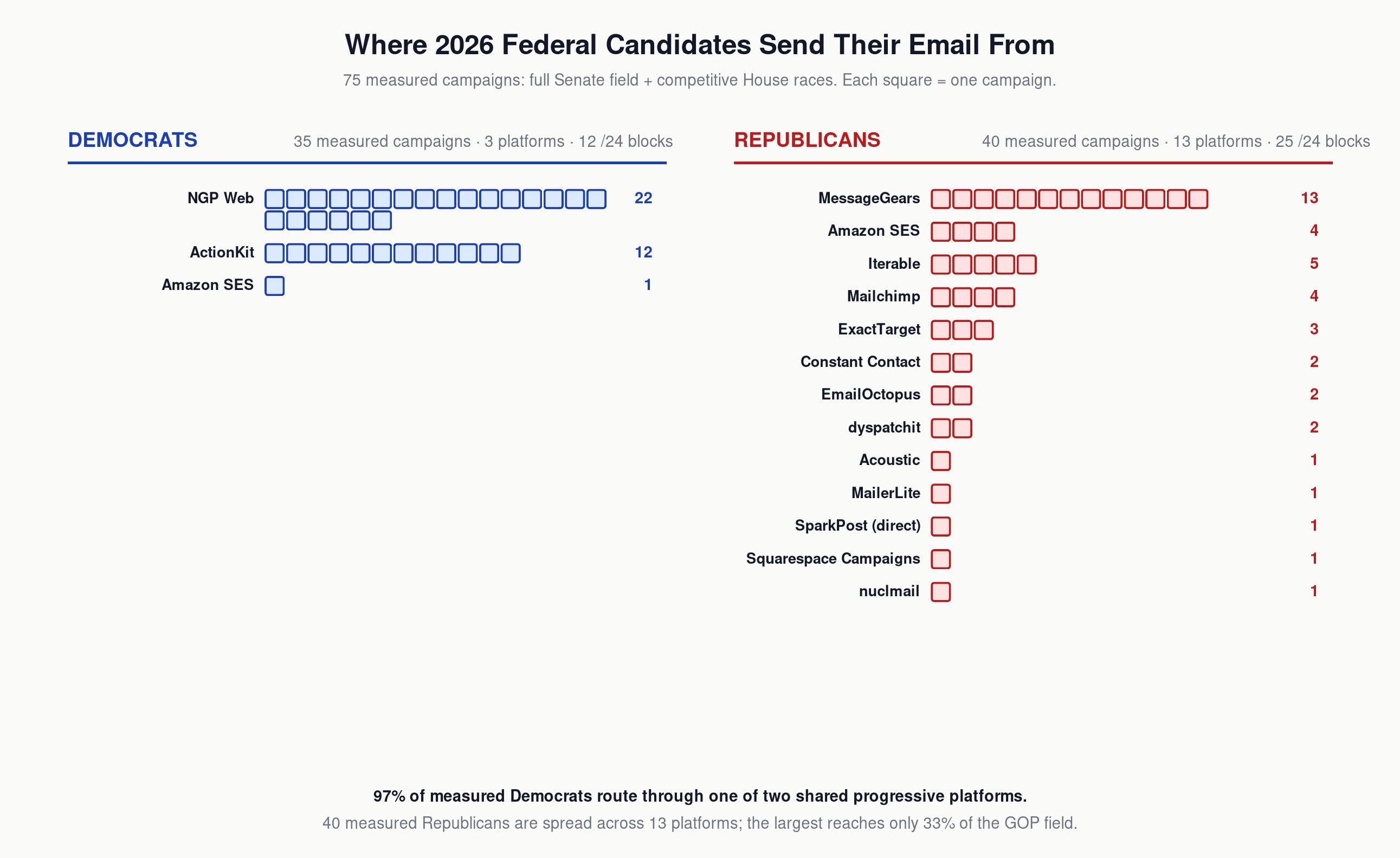
Republican campaigns are spread across an array of different email marketing platforms, none of which are exclusively dedicated to political customers in the same way as NGP VAN. That means Republican candidates are sending emails alongside commercial enterprises, small businesses, and anyone with a credit card who can sign up. This dilution is especially noticeable when we look one layer deeper at the various IP addresses campaigns send from.
In order to determine whether or not an email should reach the primary inbox rather than a promotions tab or the spam folder, inbox providers like Google and Yahoo look at the IP address a message comes from and asks: how has mail from this IP behaved? Has it been marked as spam? Have recipients engaged with it – opened, clicked, replied, etc? Has it been sending for a while? Does it send in consistent volumes?
This is where the shared infrastructure of the Left becomes a structural advantage. The reputation an IP address block earns is built across the cumulative behavior of every sender on it, over years of activity. When an NGP VAN client sends a fundraising email from one of its primary blocks, it carries a reputation built up across hundreds of campaigns, PACs, unions, and nonprofits sending billions of messages over more than a decade. A new Democratic campaign inherits that reputation on day one.
Republicans are sending from a mix of IP addresses that draw their reputation from different customer bases with no shared political context at all. For example, a handful of GOP senate campaigns send from the same IP address block as GEICO insurance and one battleground GOP House candidate shares email marketing real estate with a ski resort, a medical supply company, and a Peruvian bank, among others.
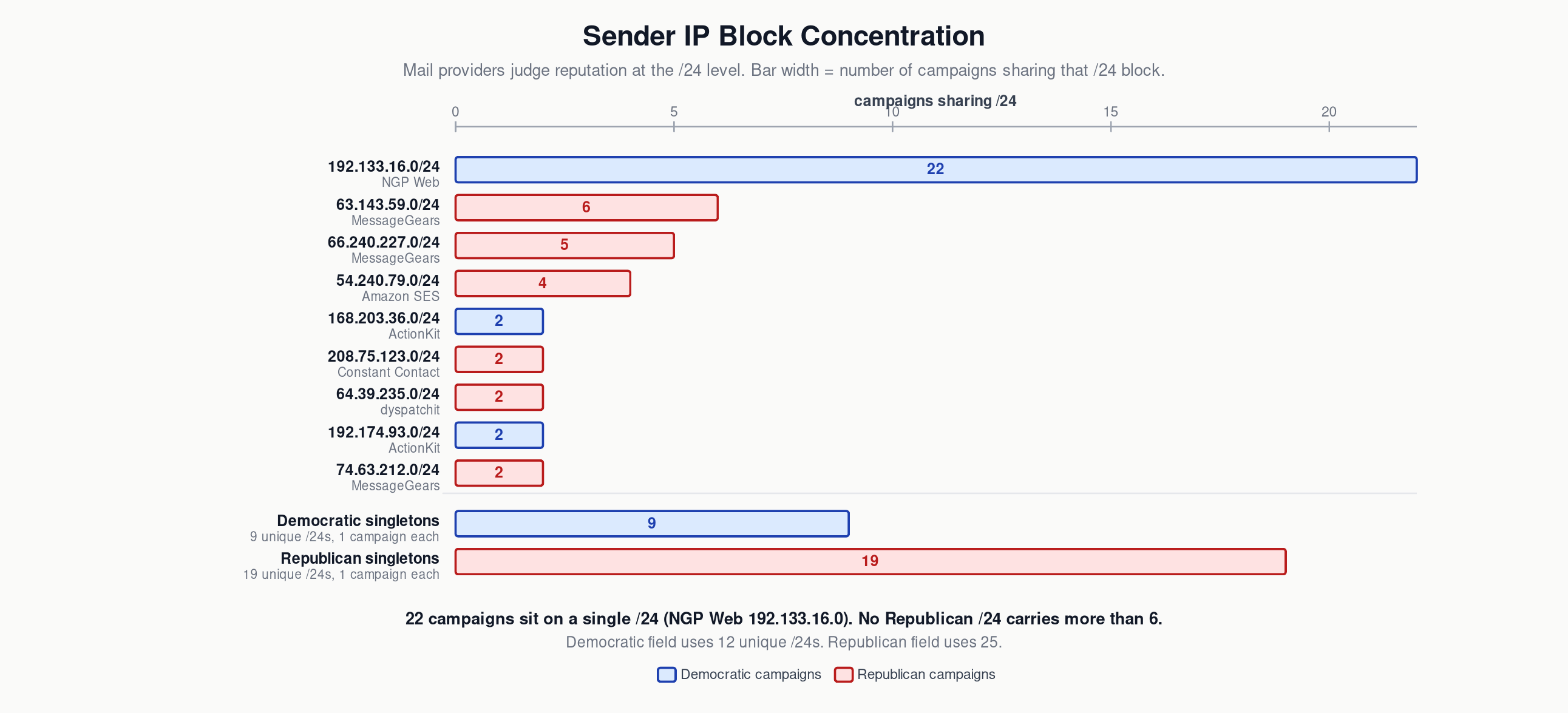
When we check each of these IP addresses against Spamhaus, the most authoritative email reputation list which is referenced by Gmail, Outlook, Yahoo, and other major inbox providers we find that they’re all clean. The email deliverability gap between parties is not about who is getting blocked. Both Republican and Democratic campaigns are meeting baseline hygiene expectations of the email marketing ecosystem.
Republican campaigns are not behind on email authentication mechanics either. DKIM signatures pass on essentially every measured GOP campaign and SPF alignment is comparable between the two parties. The structural Democratic advantage is not coming from better candidate-level configuration. It’s coming entirely from the shared infrastructure.
What Republicans lack is the layer above hygiene: a shared, professionally managed sending pool with aggregate reputation built across the entire conservative ecosystem. The consequence is that Republican campaigns are building their email reputation on narrower foundations from scratch, campaign by campaign. The strategic question then becomes whether to keep accepting the structural disadvantage of fragmented sending, or to work towards building the missing infrastructure.
The technical requirements are straightforward, but the real challenge is coordinated demand across the ecosystem and the willingness of right-of-center digital agencies to operate on a true shared-infrastructure provider rather than per-client solutions.
The compounding nature of email reputation makes this time sensitive. Every cycle that passes without consolidated Republican email sending is another cycle of Democratic campaigns teaching Gmail, Outlook, and Yahoo what trustworthy political email from one corner of the ecosystem looks like. This asymmetry does not show up as Republicans getting blocked, but in the ongoing advantage of Democrats in the inbox.